Leadership Agent Security 5 min read
AI Agents Need a Mandate, Not Just Access
On this page
An AI agent can finish its task, use the right credentials, and still make a decision the business never meant to authorize.
Before any talk of models or automation targets, I’d ask three questions. Which decisions are we handing over? Within what limits? And who stays responsible for the result?
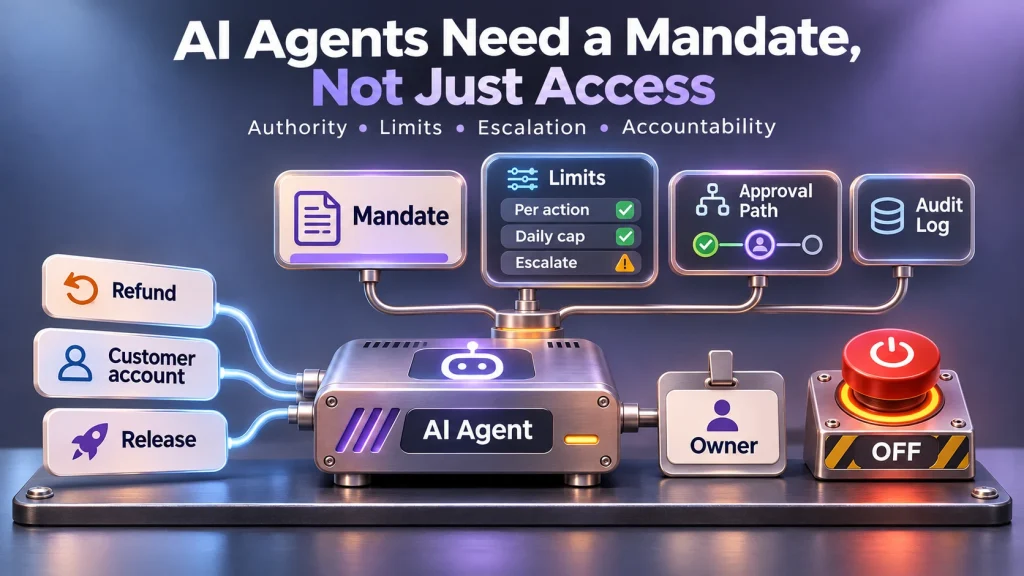
Companies already answer these questions for people, whenever they give someone purchasing authority, access to customer accounts, or permission to release software. Agents need the same clear mandate, and because they act fast, vague authority gets expensive fast.
TL;DR
- Treat an AI agent like any delegated role: a written purpose, a named owner and clear limits on what it may decide.
- Set limits by business exposure, per action and in total, and enforce them where money moves or production changes, not in the prompt.
- Let routine work run without approvals, widen autonomy only on evidence, and keep an off switch that doesn’t depend on the agent.
Define the decision the agent may make
#Forrester’s November 4 post on “least agency” separates three things that are easy to blur. Access is what an agent can reach. Authority is which decisions it can make with that access. Autonomy is how independently it makes them.
Most technical teams already know least privilege: give an account only the access it needs. Least agency, Forrester’s term, applies the same idea to decisions: keep an agent’s authority and independence at the minimum its approved purpose requires, and keep checking that they stay there.
These distinctions belong in a leadership conversation, not just a security review. A customer service agent might need access to payment records to investigate a complaint. Whether it may issue a refund is a separate decision. Whether it may issue a thousand overnight is another.
Give each agent a named business owner and a written purpose. “Help support” is too broad. “Resolve these types of requests under the approved refund policy” is a decision someone can inspect and defend.
The owner is accountable for that mandate, including the cost of making it too broad or too narrow.
Set limits around business exposure
#Imagine a retailer that brings in an agent to handle routine refunds. A limit on each refund helps, but it isn’t enough. Many small refunds can add up to a large loss, and several agents can each stay within their own limits while together going well past what the business intended.
So I’d set limits per action, per customer, per workflow and per time period. The last three are aggregate limits: caps on the total across many actions, such as total refunds per day across all agents. The numbers should reflect the business’s margins, fraud risk and ability to recover from a mistake. A supplier’s default setting can’t make that judgment for you.
Reversibility matters too. A reversible action is one you can cleanly undo if it turns out to be wrong. Updating an internal draft is reversible; sending a binding commitment to a customer isn’t. A production change you can roll back is different from deleting data you can’t recover. The harder an action is to undo, the lower its limit should be.
The useful question is how much exposure the business accepts before a person has to step in. Decide that before the agent is under pressure to finish its task.
Give routine work a clear path
#Requiring approval for every action would defeat much of the point. It also trains people to approve requests without reading them, just to clear the queue.
A short decision policy works better. Here’s an example, where “escalate” means the agent stops and hands the decision to a person. The boundaries are illustrative, not universal rules:
| Business action | May act independently | Must escalate | Accountable owner |
|---|---|---|---|
| Customer refund | An eligible request within the approved per-refund and aggregate limits | A policy exception, disputed eligibility, or a used-up allowance | Support lead |
| Staging release | A tested change within the agreed scope | An unexpected permission request or failed validation | Engineering lead |
| Production release | A pre-approved type of change with passing checks and a tested way to roll it back | A data migration, expanded scope, or no evidence it can be rolled back | Service owner |
Someone should be able to explain why each boundary exists. If everything escalates, the workflow may be a poor fit for automation. If almost nothing escalates, test whether the boundaries are actually enforced.
Enforce the mandate outside the conversation
#Writing a policy into a prompt doesn’t mean the software around the model will honor it.
A CERT-EU experiment published on October 30 shows why. In an isolated lab, using test credentials, the team modified local copies of two legitimate third-party packages that extend AI agents. They added a credential-collection step to code that the agent harness (the software around the model that loads its tools and extensions) already ran. The backdoor needed no change to the model and no extra tool for the model to call. No public release was modified. CERT-EU’s point is that controls like tool permissions and approval prompts govern the model’s actions, not the code running alongside it, which can give “a false sense of containment.”
So enforce limits where the payment, deployment or other action that matters actually happens, and make sure the agent has no route around them through another tool or identity.
Here’s what I’d ask a supplier for: show me the system refusing an action in our own workflow. Forrester’s November 5 advice to buyers of security tools for coding agents makes the same point: ask vendors to demonstrate intervention in your actual workflows, and keep what’s available now separate from roadmap promises. It also separates giving an agent security instructions, inspecting its code and blocking a risky tool call. Only the last stops an action before it happens, so that’s the one to see working.
Expand autonomy when the evidence supports it
#A successful demo is a starting point. Before widening an agent’s authority, I’d want evidence from ordinary requests, ambiguous cases, policy exceptions, and repeated actions that approach a limit.
The agent should also handle interruptions, half-finished work and uncertainty correctly. A refund that went through just before a connection failed must not be issued a second time because the workflow retried.
Weigh the business result against the cost of supervising it: wrong actions, recovery time and hours spent on escalations. An agent that needs constant intervention may need a narrower task, a better process or more reliable information.
Wider authority should come with written conditions. A significant change to the model, tools, policy or business process should trigger a fresh check of whether the old evidence still holds.
Keep the ability to withdraw authority
#Every mandate needs a practical off switch. The owner should know who can pause the workflow, revoke its credentials, and reconcile what it already did. That has to work even when the agent or its supplier is unavailable.
I’d also require a record that the agent can’t change: what it did, which policy allowed it, and where a person stepped in. It lets you hold someone accountable and recover without taking the agent’s word for what happened.
Where to start
#The real decision is how much independent action the business can justify. Write one page for each agent you run or plan to run:
- Its purpose in one sentence, and its named owner.
- What it may decide alone, and what it must escalate.
- Its per-action and aggregate limits, and where they’re enforced.
- The evidence that would justify more autonomy.
- Who can stop it, and how.
Write it before you grant access. If you can’t fill it in, the agent isn’t ready for more authority.
Got it working, or hit a snag?
Share your setup, a fix or a question. Markdown and code blocks work.
Replying to
How comments and emails are handled: Privacy.